Monday, March 27, 2006

Underground-Collective.com: Cheetah's Handbook Volume 2


The Cheetah's Handbook Vol. 1 received some great reviews. However, I never had a chance to obtain the e-book before the end of its limited release. Therefore, I was extremely excited to get a chance to read through the second volume.

Under Control (Luke Dancy)- The author describes this as a "spreadless Convincing Control." Basically it allows the performer to control a card to the bottom of the deck while the selection supposedly remains outjogged in the middle. The move "works due to its perfect combination of sleight of hand and discrepancy." The control is not easy, but performed casually looks exceedingly fair. Those familiar with Jason Alford's Angled After Burner may enjoy this variation.

Sweet Cherry Living (Kostya Kimlat)- This is very neat impromptu routine where the performer picks up two cherries and fuses their stems together. The main problem this routine is that I don't imagine you will find yourself in a position to perform it all that often and carrying cherries around just to do this effect would obviously seem a little convoluted. The bright side is the moves used in the routine are simple and natural, so you won't have to practice in advance to understand the handling. This means that the next time you happen to be in front of a bowl of cherries, you are ready to do this routine.

BVA (John Bodine)- This is one of my favorite routines in the notes although it's also one of the simplest. In fact, the entire effect takes less than 20 seconds. The routine makes use of Lee Asher's Asher Twist (or Action Half Pass) but the move is not described. While I won't argue that this routine is better than the original Asher routine, it's nice to be able to perform something different on occasion.

21 Forever (Jamie Badman)- If you have read my review of Jamie Badman's Underground Change Manuscript elsewhere on this site, you know I am a big fan of the move. When the action is motivated, this utility move can be used to great effect. This is one of those effects. A spectator chooses two cards for himself and two cards for the performer to make two Blackjack hands. He is then given the option of exchanging his hand with two different cards from the deck. Finally, he is asked if he would like to switch cards with the magician. Despite his choices being completely free, the performer always ends with a perfect Blackjack. While I do not believe this routine is the most powerful use of the Underground Change, it is a strong effect. Those interested in further applications of this move are encouraged to check out the Underground Change Manuscript and the Underground Collection Volume 2.

Meester Twister (Jack Parker)- A demo video of this effect can be seen at http://www.underground-collective.com/effects/detail.php?product_id=16. Decide for yourself if you like this effect. Personally, I find the handling awkward and the effect rather weak. This was definitely the lowlight of all the routines.

Cherry Bomb (Tyler Wilson)- This will not suit everyone. Some magicians may even find this completely this disgusting. I won't pretend to argue with them. It is...but it is also very original. While I would never be able to make this trick "play," I can imagine this being the perfect offbeat effect for an offbeat performer. This would also be appropriate for many bar situations. In short a cherry is drawn on a card and placed into the performer's mouth. When the card is removed a second later, the cherry is seen to have a tied stem.

Just One Rubber & Get Your Knot Off (John Bodine)- This is a variation on the classic torn and restored rubber band. I must warn you that the author does not provide a method for breaking the band; he simply recommends the performer use his favorite method. The technique for effecting the restoration of the band is much the same as is used in many cut and restored rope restorations: a knot is tied in the band only to vanish leaving the band restored.

Three Card Location Too (Colin Miller)- "Three participants each cut a packet of cards from the deck, remember the card they cut to and then shuffle their cards." The performer then mentally divines each card with no pumping. The author admits this is a variation of Steve Ehler's Three Card Location where the magician divines not only the spectator's selected cards, but also each card in the spectator's cut off packet. This version is more likely to fool magicians that are familiar with the original Ehler routine, but does not end with the revelation of each card in the spectator's packet. You will have to decide for yourself which suits your needs best.

Full Mental Racket (Andi Gladwin)- This is Andi's version of a Syd Segal and JC Wagner's A Logical Lesson. The routine is quick, but the presentation is entertaining. The downside is that the effect may not be worth the six card setup that is required. It's not that a six card setup is particularly extensive, but the effect is not quite powerful enough to warrant having to arrange the pack.

Wings (Kostya Kimlat)- Kostya strikes again with another food related routine. This time he provides a method for the restoration of an eaten chicken wing. I know what you're thinking...why didn't I think of that? Yeah right. I won't explain much more to keep from revealing the method, but I don't imagine you will be practicing this effect much in your living room. Who knows, though? This could be just the routine you have been searching for. My favorite part is Kostya's advice on how to end clean: "ask your kind waitress for a moist towelette." Even if it's not practical in most situations, it is still refreshing to see the creative thinking behind it.

Two Minds Without a Single Thought (Jack Parker)- The spectator selects a group of cards from the center of the deck. Those cards are cut in half, and the top cards of each packet are revealed to be mates (ex: two red Kings.) The advertising blurb for this effect reads "I'm not sure what's more entertaining, the trick or the write-up." The answer is simple, the write-up. This is not to say that the effect is bad, but I imagine I enjoyed the write-up more than my spectator would enjoy the effect.

E.J. Sandwich (Rob James)- The four Aces are placed on the table. A card is selected and signed on the face. The card vanishes and is found face down in between the Aces. Rob's handling is direct, but many magicians will steer clear of the effect due to the somewhat advanced moves employed (ex: Classic Pass, etc.)

Cheetah's Cellphones (Luke Dancy)- Luke has some very clever ideas about how to turn an ordinary cell phone into a magical utility device. I won't describe the ideas here, but I will say some of them are excellent.

Nightmare (Robert Moreland)- This is the classic Cannibal Cards routine using Robert's Ascanio Spread Finesse which is explained in full detail. For those not familiar with the plot, three selections vanish as they are placed one at a time into a packet of four queens. For the finale, the four queens vanish leaving just the three original selections. The routine is well-thought out and the presentation is entertaining. Many on internet magic forums have said this is the best handling of the Cannibal Cards ever. I will not pretend to have enough knowledge of the plot to make this argument, but you should know that others have made this comment.

Whiplash (Andi Gladwin)- Two spectators select a card and the magician selects one as well. The three cards are placed into the magicians hands and the spectators place their hands on top of his. When the hands are removed, only the magician's card remains; the two spectator selections are found face up in different parts of the deck. The advertisement claims that this is an original plot. I am not convinced. At any rate, the handling is somewhat original and certainly interesting. The procedure for controlling the selections could definitely be applied to other effects.

Overall, I was pleased with the material but not completely crazy about it. There are better ways to spend $20, but there are certainly worse. If the effects sound intriguing, shell out your money and make the purchase. Chances are you will find something that suits you. The ideas presented will, at the very least, give you some things to play with. I should mention that if you are interested in obtaining this e-book, you better act fast. According to the website, they will only be on sale until 250 copies are sold or the end of May 2006, whichever comes first.

-Available from www.Underground-Collective.com

Wednesday, March 22, 2006

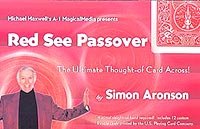
Simon Aronson: Red See Passover

Michael Close says "Red See Passover is one of the five strongest card tricks you can do, for anyone." I agree with him one hundred percent. Here's the effect description from the advertisment.

"Two spectators, Ginny and Dave, are asked to help with an experiment involving two decks of cards, one red-backed and one blue. Both decks are shuffled, and each spectator takes one. The spectators themselves each deal 12 cards face down from their respective decks. The rest of the cards are placed aside. No extra or additional cards are used.

Ginny concentrates on her mental selection. She then removes her hand from the red pile and she counts her cards face down and there are now only 11! Dave likewise counts the cards in his blue pile. He finds that there are now 13 and one of them has a red back!

The 11 red cards are then turned face up and all are fanned in front of Ginny. She is asked whether her mental selection is still there, and she finds it has vanished. Finally, the red card in the middle of the blue packet is removed and shown to be Ginny's mental selection!"

Trust me, it looks exactly as described. There are no palms, awkward counts, funny adjustments, or forces used during the entire routine. It simply could not be more direct. The routine is completely laid out in the 11 page manual explaining the trick. Simon not only gives you an explanation of the "work" involved, he also provides the script he uses when presenting the effect.

While this routine is not self-working, there is no difficult sleight-of-hand involved. The only thing difficult about the trick is that it may seem, at first, a little complicated with many things to remember. However, a few trial runs through the routine with cards in hand will convince you of how simple it really is. The most important thing is to move through the motions naturally. The routine will suffer if your actions appear to be studied.

For those afraid of using gaffed cards, I should mention that Simon describes a method of cleaning up that allows you to get rid of the gaffs when you put the red deck away leaving you with a complete blue deck ready for the next routine.

For $20 you get 12 custom Bicylce cards printed by the U.S. Playing Card Company, an 11 page manuscript detailing the workings of the routine, a complete professional script, and an impossible routine that will serve you well for a lifetime. You cannot ask for more from a product. The ads say this is the Ultimate Thought-of Card Across. While I am not usually one to declare any routine as the "ultimate," in this case, I am inclined to agree. Highly recommended.

---Available from www.llpub.com.

Friday, March 17, 2006

Patrik Kuffs: 7 by Patrick Kuffs


7 by Patrick Kuffs provides a tremendous value for the money. The routines are clever, and the descriptions are clearly written. The booklet contains material that has the possibility of playing very big for very little effort. If the effects appeal to you, purchase the booklet. I cannot imagine you will be disappointed with the methods.

French Lint- A card is selected and rubbed onto the magician's close-up pad. The magician introduces a lint remover that will supposedly pick up the D.N.A. of the card. He uses it to clean the close-up pad. When he removes the sticky sheet, the name of the card is revealed in lint. This is a fun idea that could play great for the right performer in the right situation. There are stronger revelations of selected cards, but this has got to be one of the most original.

Under the Table- The performer notices that the table he's working on is unstable. To fix it, he removes a card from the deck, folds it back outwards into quarters, and places it under the table leg. A card is then fairly selected. The deck is tabled and the magician snaps his fingers. Upon dealing through the deck, the selected card is found to be missing. The spectator is then told to remove the card from underneath the table leg. Amazingly, it is the selection.
This is a great piece to be used to frame a routine or show. Begin the routine by using the card to fix the table leg, and end the routine revealing the selection. Patrik's original version is basically self-working and extremely clean looking. However, he also provides a method for performing the routine with a signed card that takes a little more work on the part of the performer, but is completely impromptu.

Temporal Anomaly- Here's the effect. The magician borrows an analog watch. Another spectator also wearing an analog watch is asked to turn the watch dial while holding the watch behind his back to set it at a random time. The magician does the same with the borrowed watch. They bring the watches out from behind their backs without looking at them and trade watches. Finally, they draw the time depicted on each other's watches on two large pieces of paper. When the times are revealed, they match exactly.
Magicians have been performing these type of watch effects for awhile now. Often, however, the apparatus involved can set the magician's wallet back a couple of hundred dollars. This routine can be performed with two borrowed watches and no preparation. Still, this impromptu routine could play on the largest stage. The method is dead easy, but probably will not fool magicians. The routine may not look exactly as clean as it could if a gimmicked watch were used, but the fact that this is impromptu and does not cost the magician a dime makes this worth your consideration. Those interested in these type of effects should check out Richard Osterlind's Watch Routine on L & L Publishing's Mind Mysteries Vol. 1 available from www.llpub.com. Richard's routine is also impromptu and does not use a gimmicked watch.


Bottle Royale- Three paper bags are displayed. The performer asks the audience to select a bag. Once done, the magician slams his hand down on the selected bag, crushing it to the table. Again, he asks for a bag to be named, and again he slams his hand down to crush the bag. The unchosen bag is then revealed to contain a broken bottle with the jagged edge pointing up. I won't get into the debate over whether or not this idea was first conceived by Patrik or Scott Alexander. I will only say that the idea is brilliant. In Patrik's version, the audience is unaware of the contents of any of the bags. In this way, they are not aware of the danger inherent in the trick until the end. Some performers may choose to play up the danger element before the effect begins. The matter is one of personal preference, and this idea can be used to accomodate either one. This is something that audiences will surely remember.

Invisible Touch- A spectator places an X on one of the fingers of a picture of a hand drawn on the back of the magicians business card. The mark is seen be no one accept the spectator. The card is then pocketed in a business card wallet. Another spectator is asked to close their eyes and to extend their hand. The magician makes mystic motions around the spectator's hands, but does not come in contact with the spectator. Still the spectator announces he felt something touch one of his fingers. Of course, it is the finger originally marked by the first participant.
This type of routine, when presented correctly, seems very eerie to the audience. The method is dead easy and seems to be completely above board. Of particular note is Patrik's clever ruse to glimpse the information written by the spectator. This could be applied to other effects. The routine will be useful for street magicians as the props needed for the effect are minimal and the spectator reaction far outweighs the work involved. I can imagine this playing well for a TV audience as well.

P.K. Card Stab- This is a clever version of the card stab, but better routines have been published. In effect, a card is freely selected, signed, and lost in the deck. The cards are then spread face down on the table and covered with a newspaper. The newspaper is lifted just enough to allow the spectators to reach under and mix the cards themselves. The newspaper is then replaced and a knife is stabbed at a spectator chosen point. The newspaper is ripped away revealing one card impaled by the blade. Of course, it is the signed selection. The title gives a hint to the method. From a spectator's point of view, I'm not sure this appears any cleaner than most other versions of the effect. However, this does have the added benefit that it fools magicians. In the words of the author, "This routine is far from impromptu. However, for special shows, it's worth the preparation."

Jackpot!- A wine glass holding five opaque envelopes is introduced. The magician explains that the envelopes could contain prizes worth thousands of dollars. Four spectators freely select an envelope, leaving one for the magician. The spectators open their envelopes to find lottery tickets. The magician cleanly opens his envelope to find not only a lottery ticket, but a one hundred dollar bill. Obviously, this is Patrik's take on the classic Bank Night plot. First, there are absolutely no forces and no word play involved. While this is not a blockbuster effect, it makes for a nice self-contained routine that plays big and is fun for everyone involved. Allowing the spectator's to keep the lottery tickets is a nice touch (admittedly borrowed from other performers such as Richard Osterlind and Lee Earle.) It takes away the "sting" involved in other Bank Night type effects while leaving the spectator with something that really could be worth thousands of dollars. Luckily, it only costs the magician one.

The booklet also contains a "conversation" between David Acer and Patrik Kuffs that is simply hilarious. For the price, you're not going to find a much better investment. David Acer's writing style makes the booklet not only informational but entertaining to read. In fact, my only problem with David is that he cannot publish material nearly as fast as I can read it. (Come on, David. Pick up the pace a bit, would ya?) Highly recommended.

--- Available from www.DavidAcerMagic.com.

Wednesday, March 08, 2006

David Harkey & Eric Anderson: Ah-ha!


David Harkey and Eric Anderson have put together a wonderful book very much worth your consideration. Ah-Ha! (Anderson-Harkey, Harkey-Anderson) provides the perfect mix of practical material specifically designed for working magicians as well as extremely creative effects that may only be performed in special situations. The ideas presented are, at the very least, inspiring. Many of them, however, are very workable in the real world.

Fingerling- In effect, you remove a small child's finger and magically restore it to their hand. Honestly, I have not tried the routine, so I can't speak to it's effectiveness, but I can't imagine many people believing this is "real" magic.

Torque- This is cool. Street magicians and others who love to perform seemingly impromptu magic will have fun with this. A borrowed quarter is placed into a cup of hot coffee. After a moment, the coffee begins to boil. After giving it a few seconds to cool, the spectator is invited to remove the coin with a spoon. The coin is retrieved and found to be severely bent. This strikes me as something David Blaine or Chris Angel could make great use of.

Scatterbrain- For many, this will be the highlight of the book. An audience member thinks of any word on a standard newspaper page. The magician tears the newspaper in half and the audience decides which half to keep. This portion is torn in half, and again the audience decides which half to keep. This process continues until one small piece remains. Someone in the crowd closes his eyes and points to a random word on the page. Finally, the magician writes this word on a notepad. Amazingly, it matches the spectator's mentally selected word. The method is extremely simple and direct. In fact, there is very little work involved at all; many will be able to add this to their act immediately after reading the explanation.

Airlock- This is an offbeat effect where the magician apparently locks his keys in his car and magically causes the door to unlock. The illusion is interesting, but any spectator is going to believe you simply pressed a button to electronically unlock the door (even though that is not at all what happens.) This effect would have been more workable when the book was originally released, but it is now a bit outdated.

Twins- The magician introduces two cards that have been stapled together face to face. Two cards are then selected and initialed. Guess what happens next...the stapled cards are ripped apart to reveal the signed selections. This is very practical. The only downfall in the routine is that the selection procedure is a bit too cozy, causing the cards to be handled a little awkwardly at times. The handling will pass by spectators who are not accustomed to the manner in which you usually have cards signed (i.e. removed from the deck and signed largely across the face), but audience members who have seen your previous performances may feel a sense that something isn't quite right.

Squink!- A silver dollar is dropped into a shot glass and heated with a lighter where it splits into two half dollars. The half dollars are placed into the glass and change to four quarters.

DBA- A visual transformation of a spectator's business card into that of the magician. The effect is a wonderful of example of situational magic. It is perfectly motivated: you pretend you don't have a card, so you offer to write your info on the spectator's card only to transform it into one of your own. However, the routine requires you to borrow an entire stack of business cards from your spectator. While this may work in offices where plenty of cards are available, most people do not carry a complete stack with them everywhere they go.

Shufflesque- Eric Anderson's false riffle shuffle is used by many magicians today without them even knowing who published it. The shuffle looks extremely fair since the cards are riffled together fairly to begin. The "work" is done after the initial riffle. Done casually, this looks couldn't look more perfect.

Zuzu's Petals- This is the most disappointing effect in the book. Petals are plucked from a flower as the magician plays the old "she loves me, she loves me not" game. Unfortunately, the count ends on "she loves me not." To save himself, the magician magically creates a single petal on the flower. The handling is simple. So simple in fact that I highly doubt anyone will be fooled by this.

Wingding- This is a great routine for restaurant workers looking for something cool to perform for children. The magician introduces a strip of butterfly stickers (though any type will do). A snap of the fingers reveals one sticker missing. When the child looks for the butterfly, he or she finds it stuck to the back of their hand. This is a sort of Ash Trick for children. It's extremely easy to execute and leaves the child with a small memento of your performance.

Flashpack- A small piece of paper is touched to a flame. Out of the fire, the magician instantly produces a pack of cards. There's not much else to say.

Bottom Feeder- An unknown card is sandwiched in between two jokers. The packet is placed into the card case. A card is selected. The card case is opened and the card between the jokers is revealed to be the selection. The effect itself is good, but the real value is the method of "secretly adding cards to a packet already sealed inside a card case." The technique is somewhat unnatural, but with the correct flow of motions, it is still convincing.

Feeding Frenzy- The method used is basically the same as in Bottom Feeder. Three unknown cards are placed into the card box. Three cards are freely named. The cards from the box are removed and revealed to be the named selections.

Schmobius- This is another disappointing effect. Actually, it's more of a puzzle. Somehow the magician manages to tie a single knot in a rubber band. Some audience members may be intrigued, but most will shrug it off. Even worse, the authors recommend that the band not be handed out as a souvenir due to the method involved.

Bonfire- This is another effect that most who read this book will never perform because of the needed supplies, but there's no doubt that the effect is cool. Several matches are dropped into a glass. Without touching the glass, everyone concentrates on the matches. After a few seconds, they burst into flames.

East Meets West Meets South- This basically impromptu version of the pencil through bill is very convincing. It is very similar to the version explained in David Harkey's Simply Harkey with one small addition. The routine is a collaborative effort from David, Eric Anderson, and Jay Sankey.

Tour De Cartes- This seemingly innocent interlude allows you to switch decks in front of your audience. Holding the deck in his left hand, the magician reaches his empty right hand into his inside jacket pocket to produce half of a deck. Adding them to the deck, the pack is seen to contain no more than a full pack. This is repeated once more. The magician now proceeds to destroy his audience with his favorite stacked deck trick.

Petrified- I would love to see this piece actually performed. In essence this is just another version of Paul Harris Solid Deception. This time the deck not only becomes solid, it actually becomes petrified in front of the audience, breaking in two when it is dropped to the table. There is a ton of work to be done to set this thing up. In fact, I wonder how many times the authors have actually taken the time to prepare for this trick. In the words of the author, "This trick does not reset."

If Looks Could Kill- This is a very powerful Q&A routine using nothing but a stack of business cards, a stack of coin envelopes, and a marker. The spectators secretly write information about themselves on the back of the cards and seal the cards themselves into the coin envelopes. The magician then reveals the information to each of the participants "without gaffs, forces, stooges, pumps, misses, bad angles, and without overtly unfolding each answer to stay one ahead." The method is easy in execution and very convincing.

Outsmart- This is just cool. The magician asks the spectator the name of his favorite card. The spectator freely names any one. The cards are uncased and the spectator deals one card for each letter as he spells "My Favorite Card." There is no need to shift any cards after the selection is made. In fact, no sleight of hand is used during the entire routine. If you're thinking that this effect sounds too clean to be accurate, you're somewhat right. To be fair, the above description is too clean to be true, you are somewhat correct. This is not exactly what always happens. However, each of the scenarios appear to your spectators to be very clean.

Fooling Pavlov- Basically you teach your dog to perform magic. For example, you ask your spectator for his favorite and least favorite foods. Let's assume he names pizza and carrots, respectively. You give your dog a piece of bread telling him that it's pizza. Of course, he eats it immediately. When you hold out the next piece, calling it carrots, he turns away refusing to eat.

Interestingly enough, even if you never plan on performing even one of the effects found in this book, it is still worth your consideration. For me, the feeling was much the same as when I first read Paul Harris material. I knew from the beginning that I would never use some of the ideas, but reading them seemed to "stretch" my magic brain. For the size of the book, the $30 price tag is a little steep, but you have purchased far worse for the same amount of money. Based on content and the enjoyment you will get out of reading, I highly recommend this book. However, those looking for the best value for their money may be better off looking elsewhere.

Friday, March 03, 2006

Wayne Dobson: Dobson's Choice Vol. 3


If you've ever seen Wayne Dobson, you know he is a phenomenal performer. He is well respected in the magic community not only for his ability to entertain but also for the manner in which he has overcome the onset of Multiple Sclerosis. Although he now has to perform from a wheelchair, he continues to astound his audiences.

Roy Johnson's mentions in the introduction to the book that "The cruel necessity of having to adapt the technical aspects of his magic in order to cope with the onset of Multiple Sclerosis provides a bonus to any magician reading this book, because the methods employed have been stripped down to the absolute minimum of technical skill without losing, and in most cases gaining, any of the strong effects created."

Missing Think- This is a prime example of getting a lot of bang for your buck. The spectator freely selects a card from a packet and commits it to memory. He then returns the card to the packet himself and shuffles the cards. The magician removes a card from the packet and places it in his pocket. When the spectator looks for his card again, he finds it missing. The magician reveals the card in his pocket and returns it to the packet. Again the cards are missed and again the card is seen to be missing...it has jumped back to the magician's pocket. The method is extremely simple, yet clever.

4 Seen- This is Wayne's version of the old insurance card trick; basically four cards are forced and revealed in a clever way. The method involved in the force is very easy and happens basically out of the magicians hands, but requires a procedure that I would imagine would be hard to justify and somewhat easy to reconstruct.

Conjuror's Choice- Six face down cards are displayed and the spectator "freely" selects one. The other cards are turned face up to show pictures of famous magicians. When the spectator turns over their selection, they find a picture of the magician (or his business card, etc.) Wayne suggests using this routine as an opener.

X-Change- This is an extremely simple routine using the Boston Coin Box. Four coins are placed into the box which is placed under one of the corners of the close-up pad. After some byplay, the box is shown to be empty and the coins are seen to have traveled to the underside of the opposite corner of the mat. I wouldn't go out and buy a Boston Coin Box for this effect, but it could play rather strongly in the context of a full routine.

Teach a Card Trick- This is one of Wayne's trademark effects and my favorite routine in the book; the magician teaches the spectator how to perform a card trick. The magician selects a card and shows it around to the audience, the card is replaced in the deck and vanishes only to reappear in the card box previously placed in the spectator's pocket. The method could not be any simpler, and the presentation is superb.

Switch- A card is selected, but the magician finds the wrong card. He places the wrong card in the card case and removes the correct card from the deck which he then causes to change places with the wrong card in the card box. The wrong card is placed in the magician's pocket, but the right card changes to the wrong card. Finally the deck is spread and all the cards are seen to be the wrong card. The effect is too confusing and some of the method far too transparent.

Sweet- This is a practical handling for the classic coin to sugar packet. The coin is signed, and the spectator really sees the coin inside the sugar packet. Wayne suggests using stickers to place on the coin to have it marked, but it could just as easily be done by marking directly on the coin. This makes the effect something you can do at basically any restaurant as the preparation is minimal.

I Swear- This is another example of how Wayne can take an ordinary trick and turn it into a very entertaining, memorable experience for his audience. For magicians this trick amounts to nothing more than a spelling trick, but for laypeople, in the right situation, this is a trick they won't forget. The method is not new by any means, but Wayne's presentation is what counts.

TLC- A way to perform the old trick using the one-ahead principle where you supposedly predict three different events (read three thoughts) before they occur. In other versions a switch needed to be made because the predictions were not written in the order the spectators were led to believe. Wayne's method allows you to write the predictions on the cards in a way that dispels any thoughts of a switch.

Spell-Check- This is another spelling effect. Two decks are shuffled and cut by two spectators. One spectator turns over the top card of his deck. Spectator two deals from his deck one card for each letter as he spells the name of the card. The last card dealt is the selection. The effect is rather weak for the method employed. Also the magician must make an adjustment to one deck before the cards are dealt.

Janus- This is very similar to an effect marketed by Doc Eason called the Impossible Opener. This version is not much different in effect but doesn't end completely clean as in Doc's version. Even though the cards don't beg to be examined, since this version seems to bring nothing new to the table, ending clean would be preferable.

Unique Prediction- A prediction effect using the Coin Unique gimmick. The effect is forgettable on its own, but it could be a nice "mental" addition to a coin routine.

Invisible- This is a nice alternative to the standard Invisible Deck effect. The magician claims to remove an invisible deck of card from an invisible coin purse. The spectator then "freely" arrives at a selection. A folded real card is then produced from the purse frame. The card is unfolded to reveal the named card. The method is simple and the effect plays big for very little work on the part of the magician.

The booklet provides no groundbreaking ideas, but the magic presented is practical and easy-to-do. A few of these routines really pack flat and play big, but Wayne's presentation is what counts. He made his living with these tricks, some of which he has actually used on television. However, Wayne has become a star because of his presentational ability, not because of these routines. I would imagine that Wayne can make just about anything entertaining. This is not to say that booklet is not worth your consideration, but I believe these routines are more suited for a beginner.

Wednesday, March 01, 2006

Jamie Badman: Underground Change Manuscript

Just take a look at the demo video of Misdirection Monte at http://www.underground-collective.com/effects/detail.php?product_id=2 and you will see how powerful the Underground Change really is. If this is your first time viewing the video, you were probably even fooled. I know I was.

The e-book teaching the technique and routine showcased on the demo video can be purchased from the website mentioned above for around $17. For your money, you will recieve a complete description of the Underground Change utility card switch as well as routines utilizing the change. Obviously, Misdirection Monte is the showcase routine, but other effects using the change are also explained including a two card transposition, a few stickmen routines, a burnt card effect, and more. Also included are two bonus routines that do not use the move; my favorite of which is a very clever ace location by Thomas Blomberg.

The move itself, although it will take some practice, is easier than I had anticipated. It takes a kind of a knack, and your first few attempts may be frustrating, but before long you will be off and running.

You may think the price is a bit steep for learning a card move, but it is taught in great detail. The routines in the book are fun to perform and play with, but the possibilities are endless. Also, take into consideration the fact that if you put in the time to master this move, it is something you WILL use. Since it can be done with any deck, it won't sit on your shelf with other items for which you paid triple this price. If you're willing to put in a little practice time, this is highly recommended.

-Available from www.Underground-Collective.com

Paul Wilson: Martini


Here's the advertisement: "The spectator names any card. They name any number from one to fifty two. Guess where there card is? Paul’s amusing presentation brings this powerhouse effect within anyone’s reach. When the time is right, the spectator deals to the cards and finds their thought of card exactly where they wanted it! Absolutely no sleight of hand - just a devilishly simple approach. This is one of Paul’s favorite routines for any audience.

Difficulty: Beginner to Intermediate"

Obviously, this is Paul's take on the "Any Card at Any Number" card effect. The PDF file explaining the routine is available for instant download at rpaulwilson.com. Just click the Circle Of Confidence tab on the left side of the page. The cost is only $5.

Let me begin by saying that this is a clever approach to this popular plot. There is no sleight of hand, but you will have to practice to get it to flow smoothly and there are some mental calculations involved that will definitely turn some people off. Also, it is not an anytime, anywhere effect. Although the deck is not gaffed, there is a setup involved. Basically, you must be proficient with a memorized deck to be able to perform this routine, although Paul briefly describes an easier alternative that some may find more practical.

Paul's wonderful routining helps disguise the method of the trick, but you should be aware that it is not as direct as it sounds in the advertisemtent above. The spectator does not simply name a card and number and immediately count down to reveal the selection. Rather, the somewhat clever presentation covers the "work" that must be done.

Honestly, this is probably not something I will ever perform, but I'm sure Paul and others can make this trick kill. Maybe it will work for you. It is only a $5 investment to learn a simple, yet effective approach to this plot. Recommended (based on the price.)

-Available from www.RPaulWilson.com

Mathieu Bich: Mathieu Bich on PDF

Mathieu Bich has made quite a name for himself recently with effects like Erazed and Counterweight. If you want a sample of his work, you may want to consider this e-book. The PDF document available for instant download at http://leeasher.com/bich.htm can be purchased for $9.95.

I must say that, to Mathieu's credit, his effects are creative and often times very original. These routines, however, do not suit my personal style. None of the six routine included in this e-book can be done impromptu; they all contain gimmicks or apparatus that are not usually available or that I don't feel are worth carrying around. I am not at all against using gimmicks or advanced preparation to astound an audience, but the effects in this e-book are, in my opinion, not strong enough to justify the extra work.

Here's a quick rundown of the six effects (their descriptions can be read at the site mentioned above):

Erazed- This is a cool if not contrived effect. It's a nice idea to have the spectator sign a card only to have it turn blank, but you'll have to acquire the needed supplies and develop a way to justify the method involved.

Suspension of Belief- This is another neat idea, but something most of us will never perform due to the preparation (albeit minor) involved. I will say that the application of finding a chosen card is a step above the original routine.

Little Papers- Although this effect is a fooler, I was immediately turned off when I read in the description that the spectator is asked "to wet his fingertips (saliva, etc.) and place each fingertip onto each slip of paper." The routine is just not something I would ever perform; again, it feels a little too contrived.

Instant Sandwich- For the work involved, I really don't think this sandwich effect will impress a lay audience any more than any of the many, many simple sandwich locations already in print. Look at the demo on the site listed above and decide for yourself.

Marie Antoinette- This effect may be fun to perform for yourself sometime, but it's not something I would perform for an audience. Keep in mind, however, that just because it doesn't fit my style, doesn't mean you can't make it work.

Little House- I would like to spend some time perhaps playing with the clever principle at work in this effect, but this routine is not for me. Again the effect comes off as very contrived.

Overall, I was disappointed in the e-book; I definitely feel there are better products for your money. However if you're interested in Mathieu's work, the download is only $10. Also keep in mind that even though I wouldn't recommend this e-book, I have seen many Mathieu Bich effects that I do like. I just don't think this product showcases his best work. Not recommended.

-Available from www.LeeAsher.com

Michael Close: In Review

This e-book is available for download from MichaelClose.com. It contains ALL of Michael Close's MAGIC Magazine reviews from May 1995-April 2005. Over 1500 products are given thoughtful reviews. I know I do not always agree with Michael Close, but I do respect his opinion. Also, the fact that the PDF document is completely searchable is a great asset. I always consult this database before making a purchase. This is a steal at only $20.

Not only is it full of reviews, but often times Michael will provide entertaining antecdotes or suggestions during the course of the column. It is an entertaining read. Although I don't think you'll sit down and read every review, I can say that I've had a lot of fun just skimming down the pages and reading the ones that interest me. It's also kind of cool to search for products you already own as Michael frequently tells which routines he liked the most. More than once I've gone back to look at something in one of my old books or tapes that I had forgotten about.

The only downside to the book is that some of the reviews are printed more than once since you are reading Michael's original text. Some months a few reviews had to be pushed back into the next issue; the e-book will then include it in the following month as well. This, however, is not really much of a problem, because a simple click of a button sends you to the next review. The reviews are thoughtful and well written. You won't be disappointed. Highly recommended.

-Available from www.MichaelClose.com

Lee Asher: Diving Board Double

Check out the double lift used in the ambitious card sequence here: http://www.cardma.com/Video/facedownsilversurfer1.rm

That's Lee Asher utilizing his Diving Board Double to great effect. The technique is now taught in a PDF file available for instant download from LeeAsher.com. The cost is $12.95. The move is taught in great detail in the e-book along with the Acrobatic Diving Board Double in which the double card is flipped into the air, yet still lands together on top of the deck. The technique involved in the Acrobatic version will take considerably more practice to perfect, and it will probably not be something you use for a lay audience. Even Lee Asher admits that this is not a move he performs at a professional gig.

The real value for your money is the original Diving Board Double. If you already perform a good double lift, it's not that difficult to switch to the Asher version. However, the get ready may be a little more difficult for some. After playing with the double for awhile, I finally decided to stick with my standard Strike Double Lift for most of my performances. You, however, may feel differently.

If you want to perform the Diving Board Double, this e-book will undoubtedly teach you everything you need to know. Put in some practice time and you'll be on your way. However, here's the real question: Is it worth the money to "upgrade" your double lift? Well, that's up to you. Some like it's flourishy look, some don't. You'll have to make your own decision about how you want to present yourself as a performer. If it looks like something you'll use, buy it. If not, don't waste your time. Sounds simple enough doesn't it. Recommended if it fits your style.

-Available from www.LeeAsher.com

Tuesday, February 28, 2006

Michael Ammar: ETMCM Vol. 9

Open Production (Paul Harris)- An elegant four of a kind production from two one hand fans.

4 Card Reverse (Larry Jennings) - This is one of my favorite effects off of the new tapes. Four cards are clearly placed into four different places in the deck and are later revealed to be reversed in four different parts of the deck with no apparent manipulation on the part of the performer.

The Visitor (Larry Jennings)- Larry Jennings's legendary effect. A signed card seems to impossibly be in two places at once.

Impromptu, 1/2 Deck/ OOTW Plus (Michael Ammar, Paul Curry, Harry Lorayne, Aldo Colombini)- A nice handling of the Out Of This World plot. The spectator magically separates the black cards from the red cards. Well all except for the two that the magician predicted before the trick started. Totally impromptu.

Vacuum Cleaner Cards (Paul Harris)- A wonderful Paul Harris trick where the aces disappear from one half of the deck and appear with the leader ace in the other half. Michael's presentation isfull of puns that may go over in some situations, but I doubt you will ever find an audience that will respond as well as the L&L group.

21st Century 21 Card Trick (Ed Marlo)- A card effect with a presentation centering around the old 21 card trick that many laymen seem to know.

Socrate's Cards to Pocket (Philippe Socrate)- If you're scared of palming, this is a wonderful place to start. All of the palms are wonderfully covered with misdirection. Three cards are selected. Two travel individually to your pocket. Next, the whole deck (except for the last selection) travels. A wonderfully constructed routine.

The 110 lb Card Trick (Irv Weiner, Michael Ammar)- This is basically a presentational hook more than a new card trick. An Ace of Spades is place under the spectators foot. When the spectator lifts his foot, the ace has changed to the spectator's selection and the Ace is found reversed in the middle of the deck.

Triple Prediction (Brother John Hamman)- A simple routine using Balducci's Cut Deeper force to good effect.

Also included...
Fists Of Frost (Michael Ammar)
All The Non-Conformists (Michael Skinner)
Deception Perception (Allan Ackerman)

Overall the material is good, but not great. However, a few classic routines are taught. This volume will be a great asset to the beginner who may not be familiar with such routines as Out of This World, The Visitor, etc. Still, most experienced magicians would be better served purchasing another product (perhaps even a different volume of this series.)

-Available from www.llpub.com

Michael Ammar: ETMCM Vol. 8

Comedy Rising Card- A very funny, entertaining quickie. A card is selected and returned to the deck. You hold the deck in your hand and a card begins to rise out of the pack. It keeps rising until it actually appears to be floating in mid-air. The illusion is broken, however, when you turn to your side and the audience sees that the card is actually stuck to your magic wand which is tucked under your arm.

Card On Tie (Dan Korem)- This is probably the best EFFECT on the whole series. A corner is torn from a selected card and handed to a spectator as a reciept. A safety pin is inserted into the deck which is handed to a spectator. The cards are thrown at the magicians chest and the selected card appears pinned to his shirt. Of course, the corner matches.

Caller I.D. (Eric Allen)- An over-the-top yet super simple way to reveal a selected card. The phone rings during your card trick. When the spectator looks at the caller I.D., the phone displays a message that says "Incoming Call from (name of selection)."

Card In Balloon (Derek Dingle)- Won't fool magicians, but I'll have to try it in front of lay people to see how well it could play.

Impossible Miniature Rising Cards (Martin Lewis)- If you've seen this effect, you know how magical it can look. Two cards are selected from a miniature deck. A handkerchief is placed on the table with an ashtray on top. The cards are replaced in the card box and placed in the ashtray. A tall glass is then placed over the card box to prevent any tampering. One by one the selected cards rise out of the box. Everything may then be examined. WOW!

Spectator Cuts to the Aces (Elmer Biddle, Bob Veeser)- An easy to do miracle. Your audiences will love it. Created by Elmer Biddle and Bob Veeser. If you know much about magic, that pretty much tells you what moves are involved.

Weiner's Miracle Princess Cards (Irv Weiner)- A clever mentalism, thought of cards effect that, unfortunately, Michael's performance does not show. It was long and drawn out, and when it was time to reveal the selections, Ammar actually missed two times. He did a wonderful job covering his mistake with a production of the two misses from his fly. Sadly, his out was more entertaining than his attempted effect. I just don't think his performance did this bit of magic justice.

Also included...
Larry's Favorite (Larry Jennings)
Mona Lisa Card (Michael Skinner)
Anytime 4 Aces (Frank Garcia)

The performance sections are a little disappointing. I don't think Michael is as comfortable with these effects as he is with the ones in the other volumes. The teaching portions however are incredibly well done. If the effects appeal to you, this DVD is definitely worth your consideration.

-Available from www.llpub.com

Michael Ammar: ETMCM Vol. 7

Let me preface this by saying that I am a big fan of ETMCM Volumes 1-6. Where else could one learn so many classic routines in one place. The "bang for your buck" ratio was definitely a plus. The latest three volumes in the series, however, do not live up to the standard set by the first six. I am not saying that the DVD's aren't worth your consideration, but if you are new to magic, you are better off purchasing the first 2/3 of the series first.

2 Shuffles Harry (Harry Lorayne, Brother John Hammond)- This is an amazing Triumph effect with a great kicker ending. Two cards are selected and lost in the pack. The deck is then shuffled face up and face down. Finally the cards are magically caused to all face the same direction except for the two selections. It is then revealed that not only are all the cards facing the same way, but now the reds and blacks have separated. Michael teaches the Zarrow Shuffle which is needed for the effect.

Perfect Stop Trick (Ed Marlo)- This effect is similar to the Lazy Man's Card Trick taught in an earlier volume.

The Smith Myth (Fred Smith)- The effect is somewhat interesting. Two spectators select a cards which are returned to the deck. The deck is cut into two piles. One at a time cards are dealt face up from each halves. The two selections have somehow managed to arrange themselves in the same relative positions in their respective packets.

Mind Reading Chicken (Lamont Reams)- This is a very amuzing effect. It's a very cute, funny trick absolutely amazing to a lay audience. In short, an egg is broken and the name of a (forced) card is written inside in yolk.

Always Cut Cards (Larry Jennings)- A great four ace trick that could definitely be used with a gambling theme. Very simple and direct, but very impressive.

6-Cards Royal (Doug Edwards)- This is similar to Dan Garrett's Four Card Reiteration. Three Cards are removed from the deck, but when they are counted, the magician has four. He removes a card, but again the cards are counted as four. After a few such instances, the four card packet is changed into one card: the spectator's selection. Finally, the discarded cards are shown to form a Royal Flush.

Future Deck (Jack Fosberg)- I used to love this effect as a beginner. Definitely Easy To Master. This will appeal to many people. The spectator freely selects any card which you inevitably show you predicted from the very beginning.

Cards Across (Michael Ammar)- I've never used a cards across handling in my act. I've seen a few different versions, and this stands out as one of the best, but it's still not my style. This version uses envelopes.

$2,000 Transpo- Most people will have already seen this somewhere or another, but for the uninitiated, this is a very impressive feat. David Blaine even used this on one of his television specials.

Cheaters Poker (Jim Steinmeyer, Alan Wakeling)- For me this was a dissapointment. I've heard good things about the trick, but I was very unimpressed at least with this handling. Furthermore, it is not practical in most situations as an assistant (stooge) is involved.

Color Changing Deck (Paul Curry)- For those familiar with Dai Vernon's color changing deck routine taught in volume 3, I think you'll find this to be a superior version.

Overall this volume has some good material. As always Michael's teaching is superb. His style is relaxed and straight forward. Even when difficult material needs to be taught (i.e. the Zarrow Shuffle), his instruction is clear. If these effects sound interesting to you, you'll probably enjoy this volume. However, if you haven't picked up the first six DVDs, you may find your money is better spent by purchasing some of the previous volumes.

-Available from www.llpub.com

Monday, February 27, 2006

Greg Wilson: In Action DVD Vol. 3

I was a little disappointed with Greg's newest release. There is some good material on the DVD, but not near as high of quality as his previous works.

Time Card- I never really liked these types of effects. Three cards are selected by the spectators. When the cards are revealed they are seen to represent the time of day (ex: selected cards are a 2, 4, and 9- the time of day would be 2:49) Richard Sanders and David Acer have a superior version, in my opinion, on their Roadkillers tape that adds a Triumph effect. Nothing special in this version.

The Slot Machine Scam- This is pretty cool, but there are really never going to be any opportunities to perform this. First, you must have a slot machine handy and second you must have time to prepare. It would make a cool effect for a television appearance. The coolest part of the routine is based on an idea by David Acer involving placing a card into a bill slot on a vending machine. If you used the idea for a simple card change when you happen to be near a vending machine, you would get great reactions. If you don't know the principle, at least you could learn it here.

Chip on Shoulder- For me this was the best thing on the DVD. It is very similar to a routine he put on his On The Spot DVD. Basically a casino chip disappears from your hands and appears on your spectators shoulder a couple of times. The best part of the routine is that when you repeat the effect, the audience assumes the coin will reappear on the same shoulder, but it ends up on the other one.

Cut Throat- Nothing special here. Just a simple four ace production. If you like the effect, but can't pull off the "move," there are simpler methods if you think about it.

Foreign Affair- This is a very clever trick. "Each time you fold a one dollar bill, it changes into another country's currency... and finally into a perfectly examinable hundred dollar bill." This isn't really a magician fooler, but it is very visual and amazing to the audience. You may have to go to some trouble to find the currency needed to make up this trick, but you could always use American currency and make the one dollar bill change progressively into a hundred (this is the original version of the trick that Greg credits on the DVD)

The Ring Thing- This is a nice illusion, but this routine is not one that I would ever perform. There's a point in the routine where Greg places the spectator's ring on his head to produce it in the spectator's hands (he taught this on the On The Spot DVD). There is no way I would ever do this to someone else's ring; too risky in my opinion.

Son of a Switch- This is basically a transposition effect where a selected card and a joker change places a few times. The routine is ok, but the end could be a lot better. Also, on the explanation portion, he says that you need a duplicate card, although if you perform the trick as taught, you never need the duplicate. In my opinion, you would be better off to use the duplicate to enable you to do the final transpostion in the spectator's hands; this would make the routine much stronger. You could also use the duplicate to eliminate one of the card controls during the routine.

Stunt Double- This looks pretty good, but for the work involved, the audience did not seem that impressed.

Bounce No-Bounce- Nothing really new is taught here. It's just Greg's presentation for the standard Bounce No-Bounce balls. Greg uses the balls for a "Sobriety Test."

King-Size Travelers- I'll be interested to see how this routine will play for real people. Basically, the magician removes the four kings from the deck, makes them vanish, and reproduces them from four different pockets. Greg's version is easier to do than most.

The DVD concludes with footage of Greg's stand up show. The show was entertaining, but not much magic was performed. Overall, I was disappointed with this DVD, although a few things were useful. If you aren't familiar with Greg's work, you would be much better off to purchase his On The Spot DVD or Card Stunts. Unfortunately this does not represent his best material.

-Available from www.llpub.com

John Guastaferro: Second Storm

Ok, here's a breakdown of some of the effects in Second Storm. Let me start off by saying, however, that I think this is money well spent. It's not as good as the Brainstorm DVD's, but then again that's a pretty high standard to set. First the production of the lecture notes is very professional. It's spiral bound and printed on high quality paper. The 57 color pictures that accompany the text are exceptionally clear and helpful; they really add a lot to helping the reader understand exactly what the magic should look like. The only problem I have with the notes is that the binding should have been done a little differently; it's a little difficult to flip past pages as they get caught up in the binding. At times this is a little frustrating. Of course this is a minor detail that doesn't distract from the outstanding material enclosed.

Teeter Totter Aces- The presentation to this effect is good, but I don't care for the effect all that much. In my opinion, this is the weakest effect in the notes, but some may find a use for it. I like the fact the spectator does the magic, but I just think there are better ways of producing four of a kind.

Fair Trade- This is a nice impromptu quickie that would probably be better suited to be an addition to an already existing routine rather than standing on it's own. Some may like it because the fact that it only uses the four aces and four jacks (or queens or whatever.) This makes it a perfect mate for Paul Harris's Reset or John's own Intuition from the Brainstorm DVD's. I personally don't like it as well as the similar effects on the Brainstorm series.

Jokers To Go- In this effect, two jokers change places with a selected card. Darwin Ortiz has a similar effect in Cardshark where four cards change places with a single card. In my opinion John's version in better. In short, you place two jokers in a the card case. The selected card is then placed in the center of the deck. Upon spreading the deck, the two jokers are discovered face up in the middle and the selected card is found in the box.

The Stress Test- This is a commercial card revelation that many performers will definitely find a use for. I probably won't use this is paid performance (although it's strong enough to be used), but I will definitely carry this around in my wallet for impromptu settings.

Here, There, & Everywhere- I've seen very similar effects like this in other books. Basically a selected card is found in different parts of the deck. Each time it is found, it is deposited on the table. At the end, the cards on the table undergo a magical transformation and the selected card ends up in the only place it couldn't be. This is something I'll perform often. I've already tried it out on a few lay people over the last couple of days and recieved great responses. It's not entirely impromptu, but the setup is easy to arrange in front of your audience.

Turning The Tables- This is absolutely great. This is probably my favorite effect from the notes. Basically you give the deck to a spectator and walk them through performing a magic trick. They hold the cards as you place the four jacks into different spots in the deck. They square the cards and snap their fingers. Immediately the four jacks rise to the top. This is the kind of killer magic that your assistant will not forget. You give them the credit for the magic, and the presentation leaves room for a lot of audience interaction. It's pure entertainment for everyone involved. The fact that this is easy to do makes this it an instant addition to my performing arsenal. Don't understimate this gem.

The Box Illusion- This is a great idea. It's something I'll definitely be playing around with for awhile. I don't think it's reached its full potential yet. Basically you show a deck of cards in the case. You pull out a card, show it's face, and announce that you'll attempt to make it fly into your pocket. You place the card back inside the case and reach into your pocket. To your surprise the whole deck traveled to your pocket except for the original card which is found inside the otherwise empty card box. This is something you'd expect to find in a Paul Harris book.

Googly Eyes- This is a spelling effect with a clever presentation. In fact, I like the presentation much more than the effect itself. I've tried it out on a few spectators and recieved good reactions. For some reason though I suspect this will be an effect that I like more than my spectators do. I love it, they like it. Don't you just hate that.

Ultimate Fate- You saw what Jaybs thought of this effect in the post above. It's definitely very strong magic. It's similar to Aldo Columbini's Contact Colors. I remember the first time I saw Aldo's effect I thought to myself, "Wow, that's impressive, but I wish there was something that would make the ending more magical." John did just that. It does require a setup, but a simple deck switch would set you up for a killer closer for your act.

Time Will Tell- This is a simple mentalism effect that will surely be well recieved by lay audiences, but it's not something I see myself performing too often as it doesn't fit my style. In the words of John: "The handling is very simple and the reactions you'll get will far exceed the work you put into it." He's right.

Double Trouble- This is a card effect that I predict will be used by many performers. The cards change from all backs to blank, to a regular deck. The only problem for me is that I have never been able to master a reverse fan. Unfortunately that means I won't be able to perform this no doubt outstanding effect that would make a great opener.

Tricycle Cards- This is a cute packet effect that has it's roots in Darwin Ortiz's Jumping Gemini effect. It's logical, easy, and features just four cards going through a series of magical transformations. I like it a lot.

Constellation- "Dots made by a spectator on your business card visually move and rearrange themselves to spell a message." This is a simple handling for a very commercial effect. I'll try this out at my restaurant tonight. Seems to be a very nice way to hand out your business card that will increase the likelihood that your spectator will actually keep it.

Bonus effect: Silkworm- This is a silk/sponge ball routine. The routine is well structured: you seem to start with nothing and end with nothing. Here's the effect as the audience sees it: "Beginning with your hands empty, you produce a silk; change it into a sponge ball; split it into two; and cause them to travel invisibly. You then cause the sponge balls to change into one, then into a silk, then back to nothing." It's a nice routine that can be done completely in the hands. Most likely you already have a sponge ball routine in your arsenal. If you don't, this is a great way to start. If you do, you may still find some useful items in this routine. Of particular interest is the clever holdout for a spongeball he explains.

You can tell that the material was not created for the lecture notes, but rather for John's use in the real world. This means the material is commercial, relatively easy to do, creative, well structured, and magical. The notes are a pleasure to read. The instructions are clear, and the photographs are exceptional. Although the price may be more than other lecture notes, the material is definitely a step above and the notes aren't just thrown together. John is a true professional. He is careful to explain each effect clearly and credit other inventors for their contributions to his effects. I recommend this set of lecture notes without reservation.

-Available from http://homepage.mac.com/johnghome/magic/SecondStorm.htm